
New-Model Intelligence
Ferrari 296 Challenge Stradale: Why Less Power May Matter More
Ferrari has revived the Challenge Stradale name with a lighter, non-hybrid 296. Behind the extraordinary lap time lies a bigger shift in Maranello’s thinking—and a more complicated question for collectors.
By Supercar Collectible ·
 © Ferrari S.p.A.
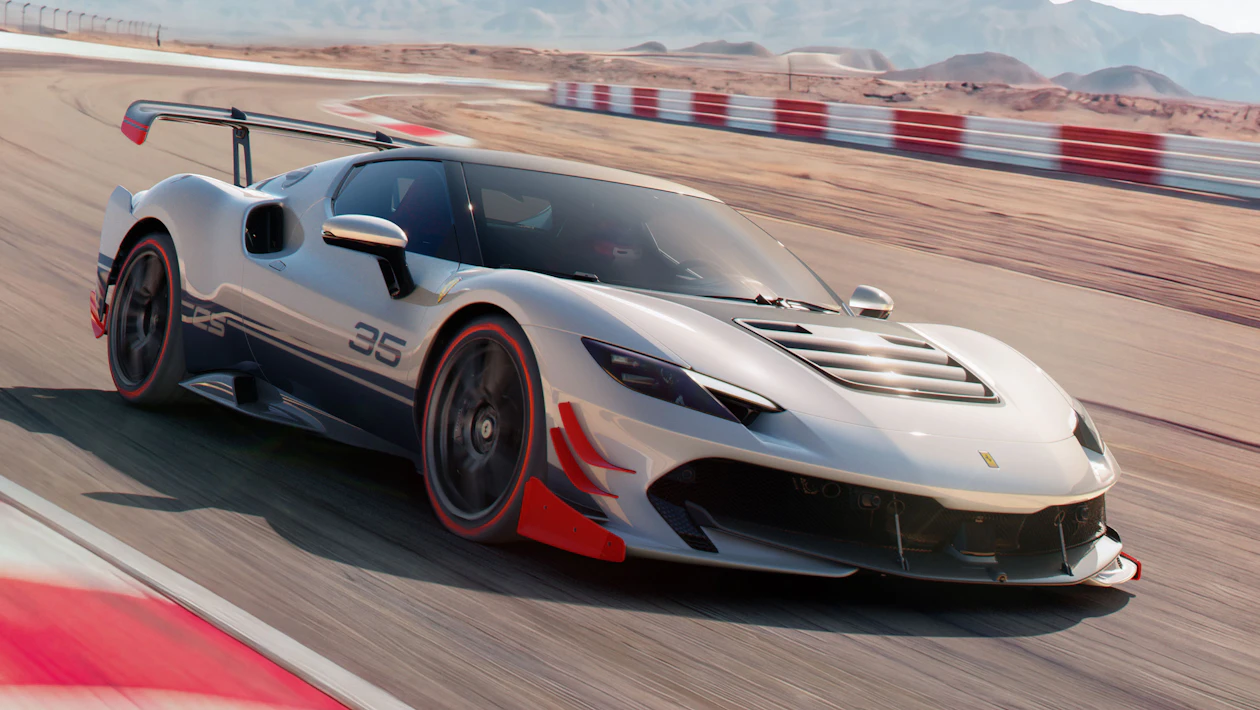
Ferrari chose the 2026 Finali Mondiali at Barcelona to reveal two closely related but very different cars: the road-legal 296 Challenge Stradale and the competition-only 296 Challenge Evo. Their shared principle is unusual for a modern high-performance launch. Both dispense with the hybrid system.
The road car's output falls to 670 CV, well below the combined figure of the 296 GTB. Yet Ferrari claims that the Challenge Stradale completes a lap of Fiorano in 1 minute 18.5 seconds—roughly half a second quicker than the more powerful 296 Speciale. That reversal is the story. This is not another attempt to win a horsepower contest; it is a different answer to what makes a Ferrari rewarding.
An engineering brief built around subtraction
The Challenge Stradale uses a 2,992 cc, 120-degree twin-turbocharged V6 producing 670 CV at 8,000 rpm and 740 Nm of torque. There is no traction motor or high-voltage drive battery. An eight-speed F1 dual-clutch transmission sends the power to the rear wheels.
Ferrari quotes a dry weight of 1,330 kg, 140 kg below the 296 GTB, and a 0–100 km/h time of 2.8 seconds. But the removal of electrification is not simply an exercise in stripping components from an existing car. Engine ancillaries, calibration, braking, weight distribution and chassis tuning had to be rethought for a combustion-only architecture.
The aero package is equally serious: a fixed rear wing, splitter, flicks, underbody treatments and airflow-control devices combine to produce a claimed 617 kg of downforce at 250 km/h, 72 per cent more than the GTB. The bespoke suspension, carbon-ceramic brakes and ABS Evo place an emphasis on repeatability rather than a spectacular single run.
The significance of these figures is the way they fit together. A lighter car with less power can be faster, more consistent and more communicative when the complete system has been engineered around the driver.
Why Ferrari has chosen this moment
For years, the direction of supercar development has been clear: higher combined outputs, more elaborate electric assistance and increasingly sophisticated intervention between the driver and the rear wheels. Ferrari has been one of the most capable proponents of that approach.
The Challenge Stradale does not reject that progress. It suggests Ferrari now sees room for two distinct definitions of performance in the same model family. The 296 GTB remains the technologically broad-ranging hybrid; the Speciale develops that architecture into an exceptionally quick, more exclusive road car. The Challenge Stradale is concerned with a narrower brief: mass, feedback, braking confidence and the kind of repeated circuit performance that matters to an experienced driver.
Our reading is that Ferrari is addressing a customer who may admire the speed of hybrid supercars but still prefers the concentration of a focused, mechanically simpler track-oriented machine. That is an editorial interpretation of the product strategy, not a stated change to Ferrari's wider electrification plans.
The name matters, but the history is not a prediction
There is a reason Ferrari chose Challenge Stradale rather than an entirely new designation. The 360 Challenge Stradale, introduced in 2003, established a recognisable formula: an authentic relationship with the one-make racing programme, visible weight reduction and a more demanding driving character on the road.
Reviving the name gives the 296 an immediate place in Ferrari's internal history. It also creates expectations. Collectors remember the 360 CS for far more than its original acceleration figures; they remember the sound, the driving feel and the moment it represented.
Those associations are an asset for the new model, but they cannot be treated as evidence that its residual values will follow the same path. The era, production context, customer base and supply are different.
Who is the Challenge Stradale for?
The most revealing point may be commercial rather than mechanical. Unlike the allocation-led 296 Speciale, the Challenge Stradale has been presented as a regular-production offering, not a numbered limited edition. Contemporary launch reporting indicates that Ferrari intends to reach new customers as well as its established clientele.
This changes the target audience. A committed trackday driver considering a Porsche 911 GT3 RS, or a first-time Ferrari buyer seeking more circuit involvement than the GTB offers, now has an unusually direct proposition from Maranello. Owners who value the experience more than an invitation-only allocation may find it especially compelling.
There is a trade-off. Wider access increases the model's opportunity to become culturally significant, but it also means future rarity cannot simply be assumed. For a collector publication, distinguishing desirability from scarcity is essential.
The Challenge Evo gives the story credibility
The parallel unveiling of the 296 Challenge Evo is more than a convenient launch pairing. Its non-hybrid V6 develops 700 CV, driving through a seven-speed F1 gearbox, and the car is designed for Ferrari's one-make racing series from 2027.
Ferrari reports 12 per cent more maximum downforce than the outgoing 296 Challenge, a four-per-cent reduction in drag in the low-drag setup and an improvement of eight-tenths of a second around Mugello. Changes to the electronic differential, traction control and braking response aim to make that pace usable over repeated laps.
The Stradale and Evo are not identical cars, nor are they interchangeable collector propositions. The road car offers the possibility of regular use. The Evo is a competition machine whose historical importance may one day depend on the chassis's race record, preparation and documented results. What connects them is a genuine, contemporary engineering programme.
The collector case: identity first, scarcity later
We see a credible historical argument for the Challenge Stradale. It is the striking combustion-only outlier in a 296 road-car family defined by plug-in hybrid technology. It revives a meaningful Ferrari designation, and its hardware is directly connected to a current customer-racing platform. These are characteristics that can give a car an identity beyond its launch window.
What has not yet been established is scarcity. Ferrari has not announced a fixed production total. The duration of the production run, eventual number built and distribution of specifications will matter just as much as the initial reaction. Nor is there a secondary-market history from which to derive a sound estimate of long-term demand.
A distinctive concept is not the same as a guaranteed investment. The Challenge Stradale may become an important collector car without becoming a reliably appreciating one. Those two outcomes should never be confused.
What future buyers should examine
The car's purpose creates an interesting collecting paradox: it will be most fully understood by owners who drive it, but strenuous circuit use may also leave more mechanical and cosmetic wear.
As examples eventually reach the resale market, originality and provenance will matter. Buyers should investigate factory configuration, delivery records, maintenance, accident and bodywork history, brake and suspension condition, and any documented track use. The condition of expensive aerodynamic and carbon components will deserve particular attention.
It is too early to name a definitive colour, seat or option combination as the desirable one. What can already be said is that coherent specification and complete documentation are likely to remain more persuasive than speculative claims of a future 'must-have' version. For the racing-only Evo, chassis-level competition history will be even more central.
Price and positioning
Italian launch reporting places the Challenge Stradale at approximately €291,000–€291,500, with market-specific taxation and equipment affecting the final cost. Deliveries are expected during 2027; timing will differ by region.
That is an interesting pricing decision. A car capable of a faster claimed Fiorano lap than the Speciale is not necessarily the higher-priced or rarer collector proposition. Ferrari is separating the value of a pure driving brief from the economics of an allocation-driven special series. The market will ultimately decide what that distinction is worth.
Supercar Collectible's view
The 296 Challenge Stradale is relevant because it captures a choice Ferrari did not have to make. Maranello could have given the 296 another power increase and a louder specification sheet. Instead, it engineered a lighter, non-hybrid alternative and gave it one of the most evocative names in its modern performance-car vocabulary.
We would not yet call it a future blue-chip collectible. There is no production ceiling to support that claim, no meaningful resale data and no history of how owners will actually use the car. What we can say is that it has a clear place in Ferrari's evolving story—one defined not by the highest number, but by a deliberate preference for immediacy and physical involvement.
That makes the Challenge Stradale worth following from its first deliveries onward. Its eventual collector standing will be earned by the cars, their owners and the market, not guaranteed by the badge.
Technical notes and reporting basis
Revealed 21 November 2026 at Ferrari Finali Mondiali, Circuit de Barcelona-Catalunya. All stated vehicle performance figures, masses and aerodynamic values are manufacturer claims, not independent test results. Ferrari 296 Challenge Stradale: 2,992 cc twin-turbo V6; 670 CV; 740 Nm; eight-speed dual-clutch; 1,330 kg dry; 0–100 km/h in 2.8 seconds; 617 kg downforce at 250 km/h; Fiorano 1:18.5. Ferrari 296 Challenge Evo: 700 CV; seven-speed F1 transmission; competition-only; 2027 debut.
Collector commentary, buyer segmentation and future-market discussion are independent Supercar Collectible editorial analysis. Price and availability are launch-period reports and may change by market.
Ferrari Magazine · Double the Challenge
Ferrari's official editorial introduction to the road-going Stradale and competition-only Challenge Evo, published 21 November 2026.
Read Ferrari Magazine ↗Top Gear · Launch positioning and production status
Contemporary reporting on the regular-production positioning, technical changes and buyer appeal of the 296 Challenge Stradale.
Read independent launch reporting ↗Car and Driver · Pricing and technical context
Independent coverage of Ferrari's specifications, intended audience, reported Italian price and deliveries.
Read launch coverage ↗